6 Core Human Needs for Sustainable Performance
I've been preparing a workshop for managers this month and one of the addressed topics is sustainable performance that is built on a foundation of 6 core human needs: meaning, progress, recognition, connection, play and rest. I've put these needs into a visual framework so they're easier to see and discuss.
You can use this as a "self-check" on your own motivation and energy levels. Whether you're leading a large team or just leading yourself, these needs apply to all of us. Use this diagnostic tool and find out which need requires your attention now, and apply some of the strategies below to manage them.
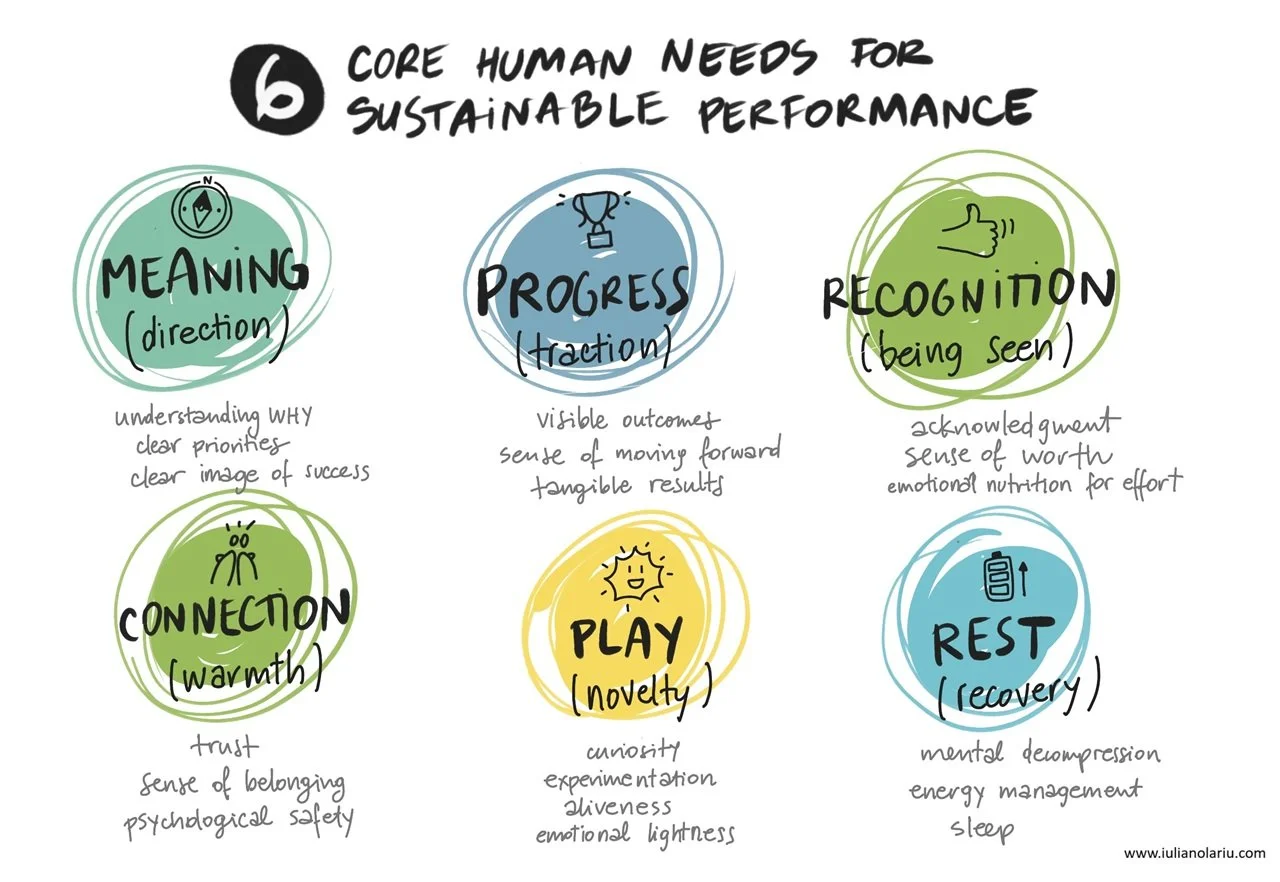
Think of these six needs as your fuel tanks. When they're full, motivation flows naturally. When they're empty, everything feels harder. Keep in mind that quite often burnout doesn't come from working hard. It comes from core needs going unfed for too long.
1. Meaning and Direction
What it means: Understanding why your work matters, what success looks like and what you're not doing.
Warning signs: Everything feels urgent, priorities change weekly, you wait for instructions instead of taking initiative, work feels pointless.
What you can do:
Clarify your top 3 priorities for the next 2-4 weeks
Ask: "What are we optimizing for right now?"
Connect your tasks to real impact (who benefits and how)
Make trade-offs explicit: "If I do X, I'm not doing Y"
If direction is unclear, ask for it
2. Progress and Traction
What it means: The feeling that your effort creates real outcomes, not just activity.
Warning signs: You're incredibly busy but nothing feels finished, you've lost ownership of your work, motivation dips even when you're trying.
What you can do:
Focus on finishing things, not just starting them
Keep a "done list": write down what actually moved forward
Make your work visible (even just for yourself)
Define what "done" means
Ask for help removing blockers
3. Recognition and Being Seen
What it means: Knowing that your effort matters and someone notices. Recognition is about basic human feedback that tells you your contribution has value.
Warning signs: You stop trying beyond the minimum, feel invisible even when working hard, become sensitive to criticism.
What you can do:
Notice your own wins (write them down)
If you manage others, be specific: "What you did + impact + why it mattered"
Recognise your invisible work: the coordination, problem-prevention, mentoring
Speak up about your contributions
Ask for feedback: "What's one thing I should keep doing?"
4. Connection and Warmth
What it means: Feeling like you belong and can speak up safely. Collaboration only works when there's trust.
Warning signs: You stay silent in meetings, avoid conflict, stop asking for help, feel isolated despite constant interaction.
What you can do:
Admit when you don't know something (it builds trust)
Check in with colleagues (beyond work)
When there's tension, address it quickly: name it, clarify, reset
Find one person you can be honest with about workload and energy
If you lead, create safe space for people to open-up
5. Play, Novelty and Lightness
What it means: Space for experimentation, curiosity and not taking everything so seriously. Without novelty and experimentation, work becomes rigid and joyless.
Warning signs: Creativity dries up, you stop proposing ideas, fear mistakes, work feels heavy and joyless.
What you can do:
Run small experiments: "What's one thing I could test this week?"
Ask "What did I learn?" instead of beating yourself up
Try something imperfect or reduce your own perfectionism
Find moments of lightness
Share what you're learning or working on
6. Rest and Recovery
What it means: Recovery isn't just sleep. It's breathing room, fewer interruptions and space to reset your attention. Your brain isn't a machine that runs continuously at peak performance. It needs recovery cycles: periods where you can think deeply without interruption, step back from constant urgency and let your nervous system settle.
Warning signs: You make more mistakes, feel irritable, seem busy all the time but accomplish less, everything feels reactive.
What you can do:
Block 2-4 hours weekly for focused work (no meetings, no interruptions)
Reduce multitasking/context-switching: batch similar tasks together
Learn to say NO
Create an end-of-day reset ritual
You don't need to fill all these tanks to 100% every day. That is impossible. But you do need to monitor them. Use this visual framework as a diagnostic tool. When you feel resistance in your work or see a dip in your (team's) energy, stop and ask: "Which of these six needs is asking for attention right now?"
Start here:
Look at these six needs.
Which one feels most depleted right now?
Pick one action from that section and try it this week.
You don't need to fix everything at once. You just need to start refilling the tank that's running empty.
